
The Mysterious Beljeans, a Forgotten Motown Voice, and an Unexpected Discovery in a 1963 Billboard Magazine
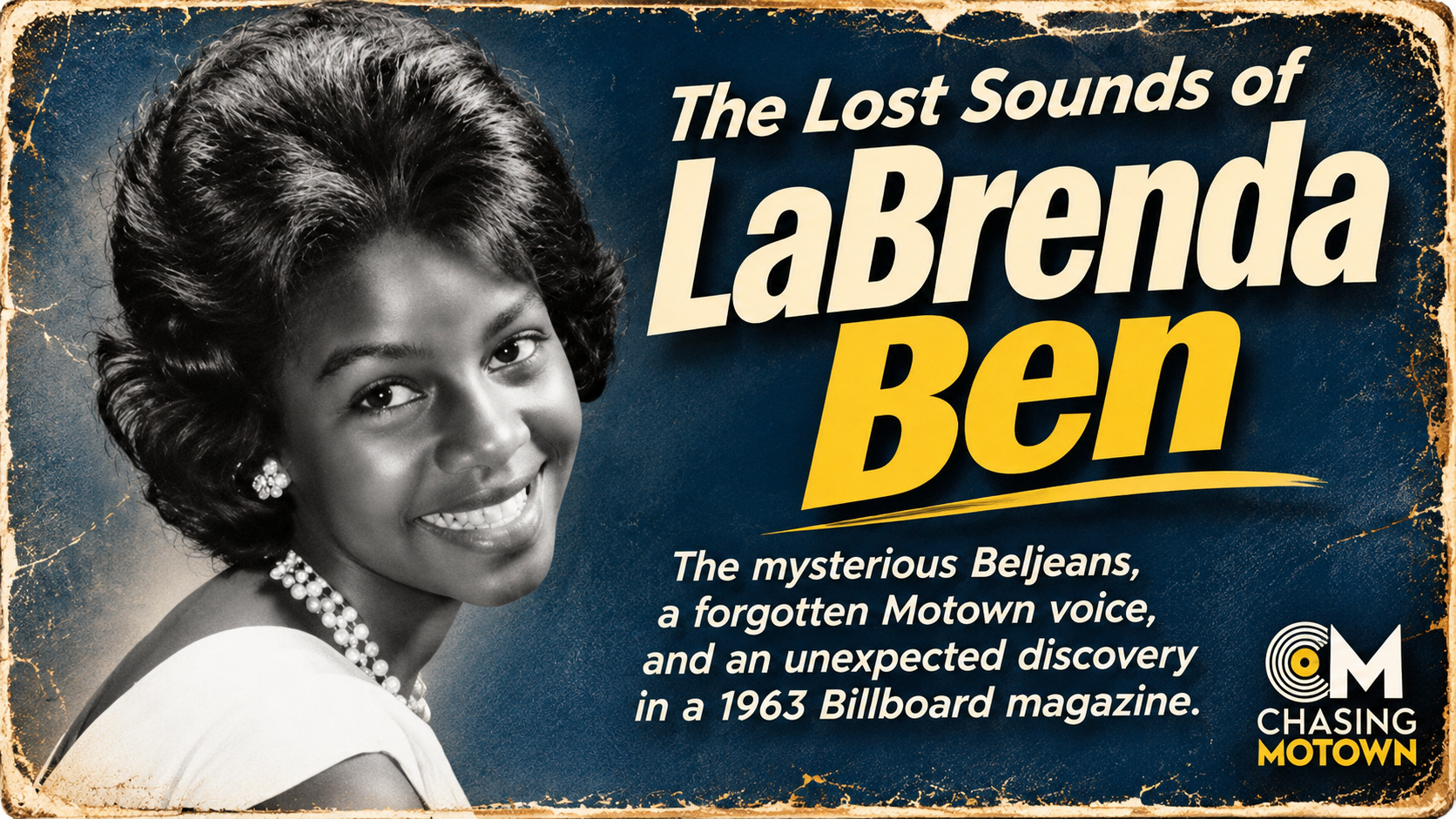
LaBrenda Ben, one of the distinctive voices from Motown's formative years, in a promotional photograph from the early 1960s. The Detroit singer recorded for the Motown and Gordy labels, leaving behind a collection of soulful recordings that remain treasured by collectors and enthusiasts of the label's early history.
There are certain Motown artists whose recordings have fascinated me for years, even though I know relatively little about the people behind them.
LaBrenda Ben is one of those artists.
Just two original Motown singles, four sides in all, and a collection of previously unreleased recordings that have gradually surfaced over the years. Not much of a commercial discography, particularly when compared with the extraordinary volume of music coming out of Hitsville during the 1960s.
But what a voice!
I've always found something captivating about LaBrenda's singing. There's a richness to her voice, a certain gospel/bluesy quality, and a personality that comes through whether she's tackling an uptempo dance number or something more restrained.
Among my favorites are "I Can't Help It, I Gotta Dance," "Just Be Yourself," and "The Chaperone." And whenever I come across another previously unreleased recording by her, I'm interested before I've even heard it.
To me, she's one of those early artists who truly had an individual sound, which I largely attribute to George Fowler's productions. I've often wondered how his sound might have evolved had they stayed at Motown throughout 1964 and 1965, when the Motown sound had fully developed.
But the more I've explored LaBrenda's recordings, the more I've discovered that her story reaches beyond the music itself.
There are connections to the Vandellas, the Downbeats, Norman Whitfield, and even Stevie Wonder. There's the involvement of songwriter and producer George Fowler, who was reportedly responsible for bringing her to Motown.
And then there's the mystery of the Beljeans.
It's a question Motown collectors have been trying to answer for decades: Just who WERE the Beljeans?
The group was credited alongside LaBrenda Ben on her first single, but their identity has remained a subject of debate. Were they the Vandellas? The Andantes? Or another group entirely?
I thought we had a pretty good answer.
Then I came across something published in 1963 that made me reconsider everything.
But first, a little background.
LaBrenda Ben Arrives at Motown
LaBrenda Ben entered the Motown picture in 1962, reportedly through her husband, songwriter, keyboardist, and producer George Fowler.
Fowler was part of Motown's early creative operation and would later become associated with the company's short-lived gospel subsidiary, Divinity Records.
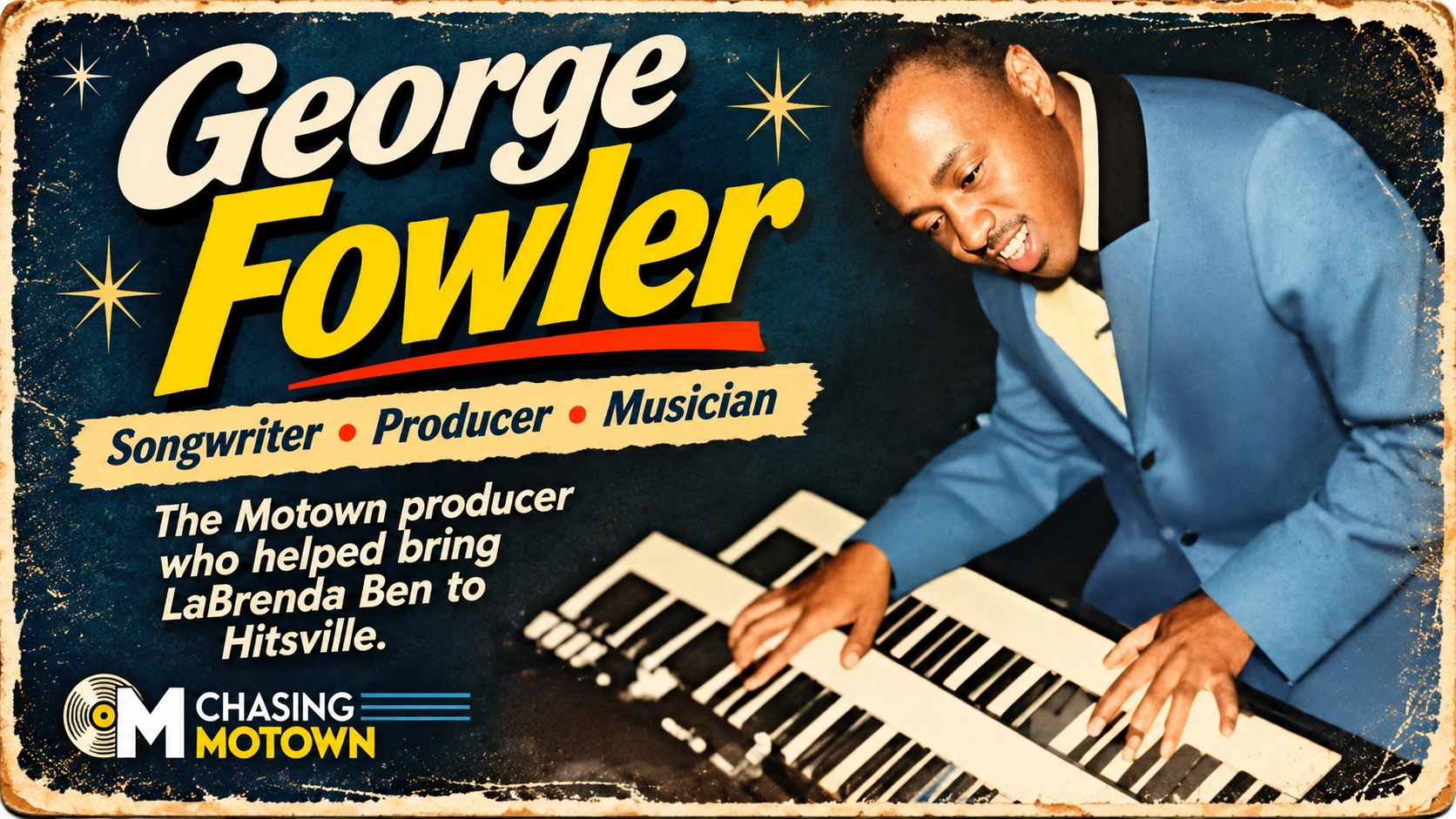
George Fowler, songwriter, producer, and musician associated with Motown's early years, pictured playing a keyboard instrument. Fowler helped bring LaBrenda Ben to Motown in 1962 and played an important role in shaping her early recordings.
Although their marriage has been mentioned in accounts of LaBrenda's career, the surviving biographical information about her remains surprisingly limited.
We know considerably more about her recordings than we do about her personal life.
According to the research presented by Motown Junkies and the liner notes to The Complete Motown Singles, LaBrenda began recording at Hitsville in April 1962.
Her first commercial release would arrive later that year, although the story behind it was anything but straightforward.
In fact, the record had already been released by somebody else.
The Curious Case of "Camel Walk"
In July 1962, Motown released "Camel Walk" by Saundra Mallett and the Vandellas on its Tamla label.
This was before Martha Reeves became established as the group's lead singer.
The record didn't become a hit, but apparently somebody at Motown believed the song deserved another opportunity.
That somebody was Berry Gordy, who had written and produced it.
Rather than recording an entirely new version from scratch, Motown reused the existing recording, replacing Saundra Mallett's lead vocal with one by LaBrenda Ben.
Same basic recording. Different lead singer.
This wasn't the only occasion when Motown would revisit existing material or repurpose recordings, but it's an especially interesting example because of what happened next.
LaBrenda's version was prepared for release on the Motown label as M 1033, backed with "The Chaperone."
And here's where the story begins to get complicated.
Early Motown pressings credited the A-side to LaBrenda Ben and the Vandellas.
But when the single appeared on the Gordy label as G 7009, the credit had changed.
It now read:
LaBrenda Ben and the Beljeans.
The Vandellas had disappeared from the label.
And the Beljeans had arrived.
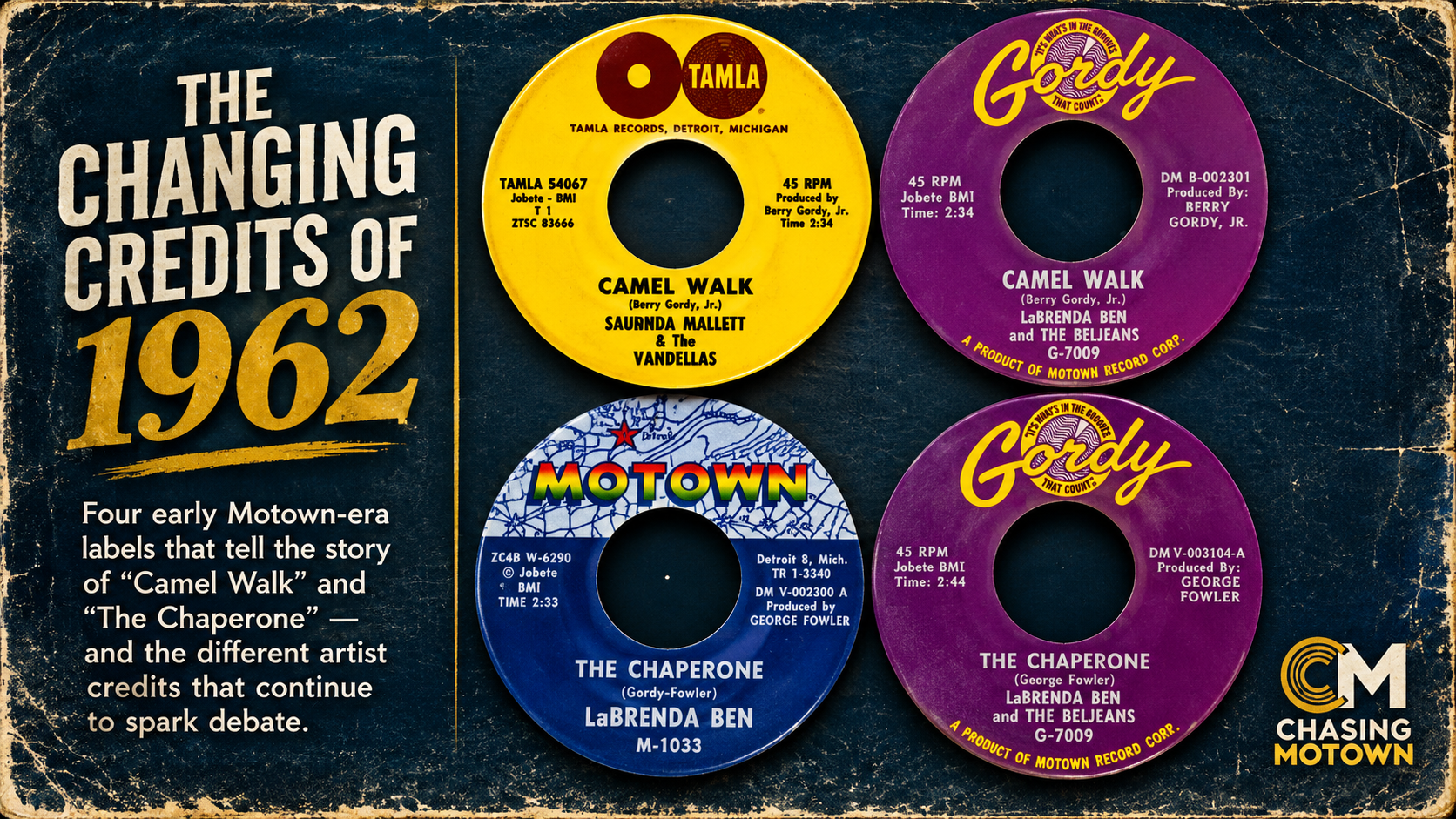
Four original Motown-era record labels from 1962 illustrate the changing artist credits on “Camel Walk” and “The Chaperone.” The Tamla release credits Saundra Mallett and the Vandellas, while subsequent Motown and Gordy pressings credit LaBrenda Ben either alone or alongside the Beljeans.
Who Were the Beljeans?
Cool name, by the way!
But who were they?
For years, the most obvious explanation seemed to be that the Beljeans were simply another name for the Vandellas.
After all, LaBrenda's "Camel Walk" was built around a recording originally made by Saundra Mallett and the Vandellas. And the original Motown pressing actually carried the Vandellas' name.
In The Motown Encyclopedia, Graham Betts discusses the unusual release history and suggests that Motown may have wanted to distance the Vandellas from LaBrenda's single as Martha Reeves and the group's career began developing.
It's a reasonable theory, although we don't have documentation establishing that this was Motown's intention.
But the story becomes even more interesting when we turn to the Andantes.
The Andantes were among Motown's most prolific background vocalists. Their voices appeared on an extraordinary number of recordings, often without the recognition they deserved.
In a 2015 discussion on Motown Junkies, researcher Robb Klein reported that Louvain Demps of the Andantes had identified the Beljeans as the Andantes.
That seemed like a pretty convincing answer.
After all, who better to know than someone who actually sang on those records?
And with the Andantes appearing on so many Motown sessions, the explanation certainly made sense.
But then I started digging through old issues of Billboard.
And that's when things took an unexpected turn.
A 1963 Billboard Article Changes the Story
On May 4, 1963, Billboard published a column by Nick Biro titled "R&B Roundup."
The article covered the Motortown Revue's engagement at Chicago's Regal Theater, where the company was enjoying considerable success.
Biro mentioned various Motown personalities visiting Chicago, including Berry Gordy, Mary Wells, and members of the Marvelettes.
But tucked into that column was a particularly intriguing reference to two women who had visited with the reporter.
One was Sandra Edwards.
The other was Billie Jean Brown.
And Biro identified them as the two women behind the Beljeans' recording of "Camelwalk" on Gordy.
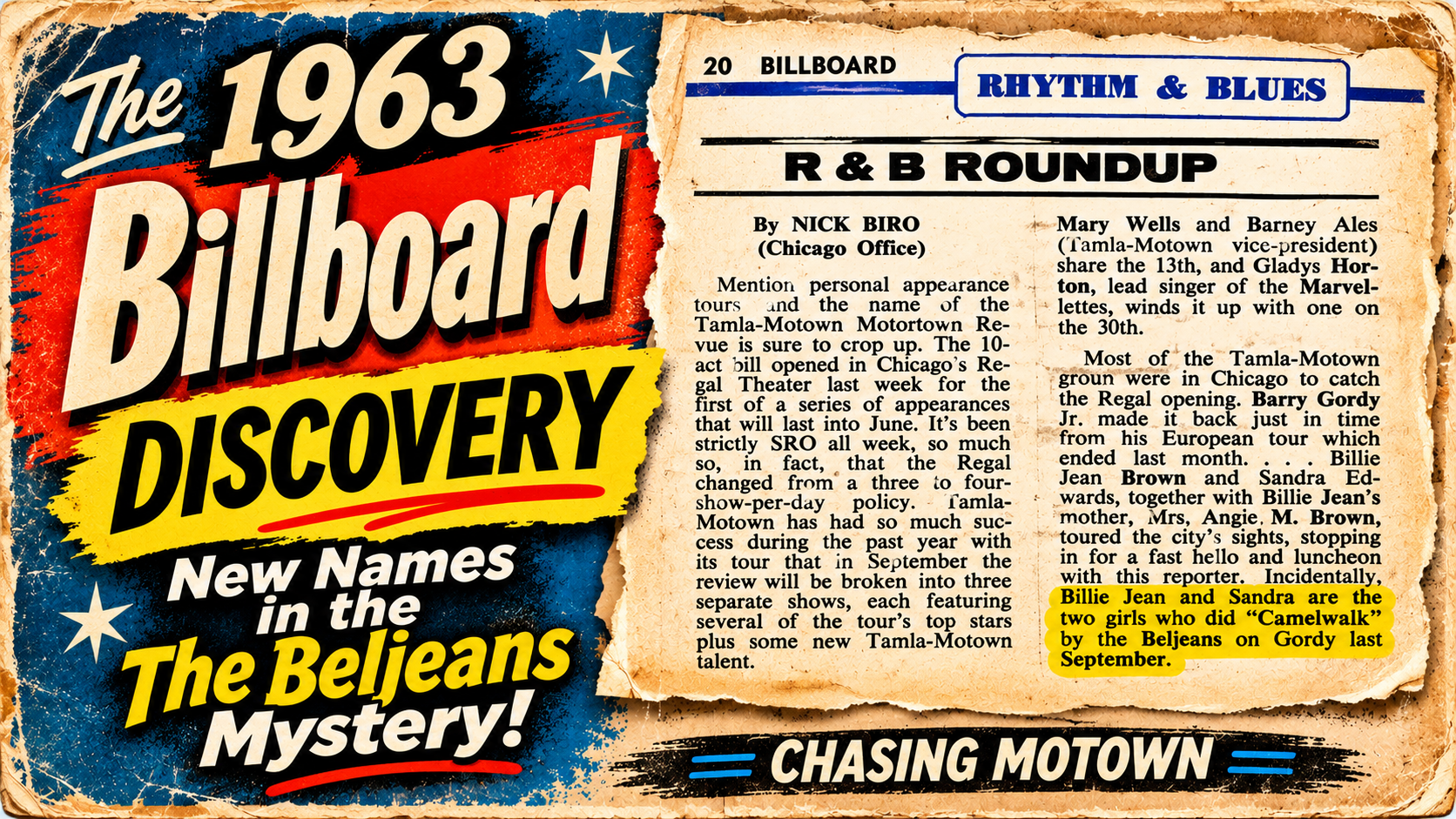
A remarkable discovery in the May 4, 1963 issue of Billboard magazine. In his “R&B Roundup” column, Nick Biro identifies Billie Jean Brown and Sandra Edwards as the two women behind the Beljeans' recording of “Camel Walk” on Motown's Gordy label, introducing new evidence into a decades-old mystery.
Wait a minute.
Billie Jean Brown?
Now THAT caught my attention!
Sandra Edwards was an interesting name in her own right. She was, in fact, Saundra Mallett, the singer who had already recorded "Camel Walk" with the Vandellas in 1962 and who would later become the lead singer of the Elgins.
The name appears as Sandra Edwards in the 1963 Billboard article, while she is also documented as Saundra Mallett Edwards. It's an important distinction because we're talking about the same woman, not two different singers.
So her appearance in the story wasn't entirely unexpected.
But Billie Jean Brown? Well, now that was an even bigger surprise!
I had to read that passage again.
For those familiar with Motown's inner workings, Billie Jean Brown was no ordinary employee. She was one of the most influential women behind the scenes at Hitsville U.S.A.
Brown arrived at Motown in 1960 while still attending Detroit's Cass Technical High School. Initially recruited to help with writing assignments, including album liner notes, she eventually became head of the company's Quality Control Department.
And this was no minor position.
Brown helped oversee Motown's famous Friday morning listening sessions, where producers, songwriters, and executives evaluated new recordings and debated which deserved release. Her opinions carried considerable weight with Berry Gordy, and she was known for speaking her mind, even when powerful producers disagreed.
She was also a songwriter, with credits that included Martha Reeves and the Vandellas' "I Promise to Wait My Love" and Shorty Long's "Here Comes the Judge."
In other words, Billie Jean Brown was someone who helped determine which Motown records the public would hear.
But was she also someone who occasionally stepped behind a microphone?
That's what makes her appearance in that 1963 Billboard article so unexpected.
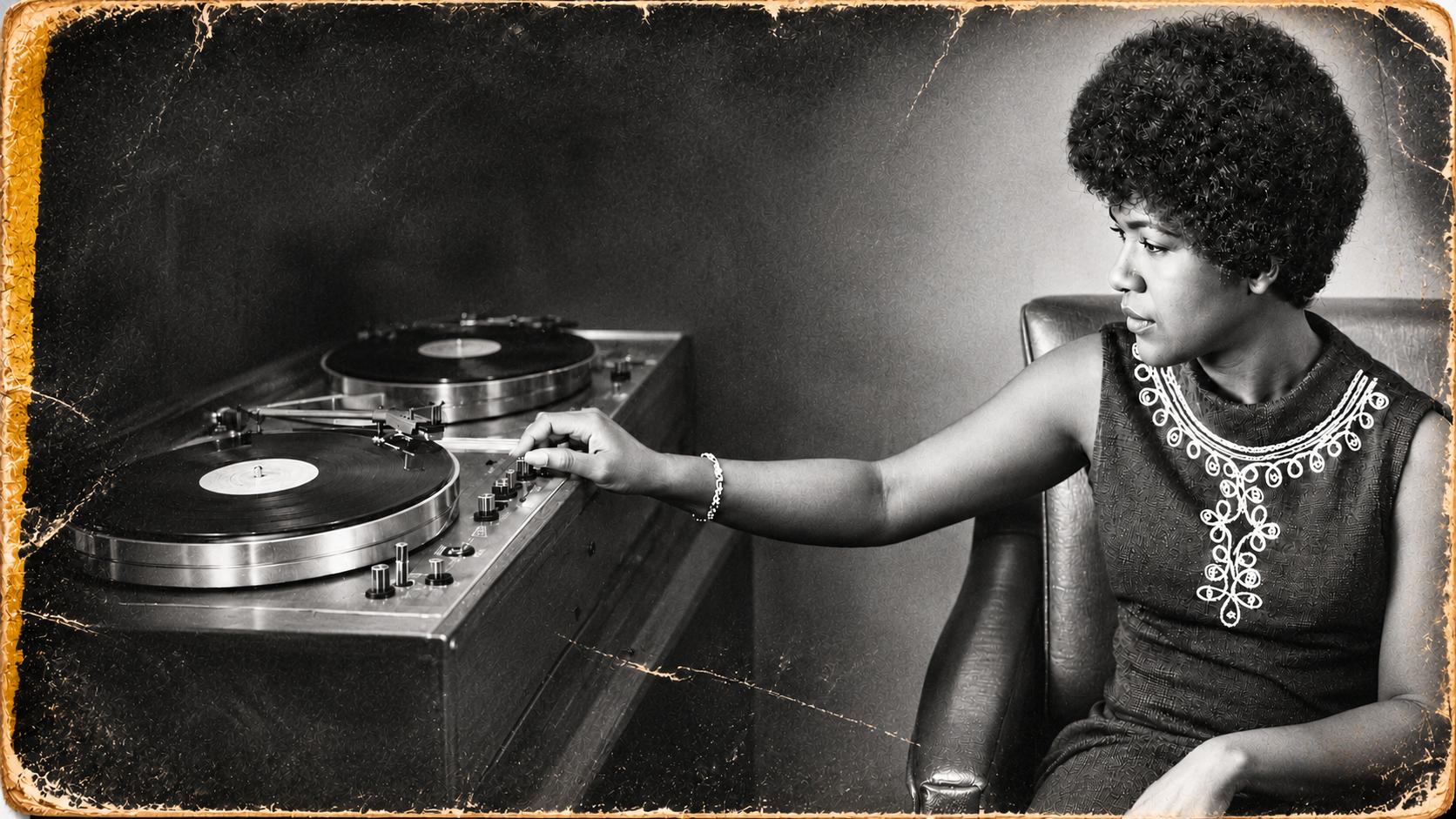
Billie Jean Brown, Motown Records' influential head of Quality Control, pictured at a record-playing console during her years at Hitsville U.S.A.
Was this a mistake? Was it publicity information supplied to Billboard? Or had we just stumbled upon an entirely different explanation for who the Beljeans actually were?
Could Sandra Edwards and Billie Jean Brown really have been the voices behind LaBrenda Ben on "Camel Walk"?
I don't know. But I certainly wasn't expecting to find their names in a Billboard article published in 1963, when the record was still relatively new.
And that's what makes this discovery so fascinating. Unlike the recollections and theories that surfaced decades later, this was a contemporary account. It doesn't necessarily settle the question, but it gives us something new to consider.
The Vandellas, the Andantes, or Someone Else?
We now have several pieces of evidence that don't fit neatly together.
First, there's the original Motown pressing of "Camel Walk," which identifies the Vandellas.
Then there's the Gordy release, which substitutes the name Beljeans.
Next, there's the recollection attributed to Louvain Demps identifying the Beljeans as the Andantes.
And finally, there's Nick Biro's contemporary Billboard report naming Sandra Edwards and Billie Jean Brown.
To complicate matters further, the two sides of LaBrenda's first single may not have featured the same background vocalists.
"The Chaperone," written by George Fowler, was reportedly recorded in April 1962, before the later "Camel Walk" release was assembled. The original Motown pressing credited that side simply to LaBrenda Ben.
So even if we can establish precisely who sang on "Camel Walk," that doesn't automatically identify every voice heard on "The Chaperone."
And it's worth remembering something else.
The Andantes participated in an enormous number of recording sessions over the years. Recollections of individual sessions from more than half a century earlier can understandably differ, particularly when the singers themselves were so busy.
None of this diminishes Louvain Demps' importance as a firsthand witness.
But neither can we ignore a contemporary report that explicitly names two other women.
I also find it interesting that Billboard places the Beljeans' Gordy recording in September 1962, while some later discographies list December. That discrepancy deserves further examination, especially given the different Motown and Gordy pressings.
For now, I'm not prepared to declare the mystery completely solved.
But I certainly believe the 1963 report deserves a prominent place in any discussion of the Beljeans.
And I wonder how many Motown collectors have ever seen it.
Beyond the Beljeans: LaBrenda Finds Her Own Voice
As interesting as the "Camel Walk" story is, I don't think that recording represents the best of LaBrenda Ben.
For that, I'd point to "The Chaperone" and her second single, "Just Be Yourself."
"The Chaperone," written by George Fowler, gives LaBrenda an opportunity to establish a different musical personality from the one heard on "Camel Walk."
And "Just Be Yourself," released on Gordy in 1963, is another favorite of mine.
Written by George Fowler and Stanley "Mike" Ossman, it's a very different kind of Motown recording from the uptempo material most listeners associate with the company.
There's something wonderfully distinctive about LaBrenda's delivery.
The record's flip side, "I Can't Help It, I Gotta Dance," is another personal favorite.
I love that she even mentions the Contours in the lyrics!
And those background vocals have always intrigued me. Every time I hear the record, there's something in the blend that reminds me of Florence Ballard, although the published session credits identify the Andantes.
That's one of the pleasures of exploring Motown's lesser-known recordings. You start listening for familiar voices, arrangements, instrumental passages, and songwriting styles.
Sometimes you're right.
Sometimes the credits tell you something completely different.
And sometimes the mystery only gets bigger.
Another Recording, Another Connection
One of the most intriguing recordings in LaBrenda's surviving catalog is "Do You Know What I'm Talking About?"
The song was written by Brian Holland, Norman Whitfield, and Eddie Kendricks, and published by Jobete in June 1964.
LaBrenda recorded a version produced by Norman Whitfield, which eventually appeared on Ace Records' 2013 compilation Finders Keepers: Motown Girls 1961–67.
But she wasn't the only Motown artist to record it.
The Downbeats, the male vocal group that would eventually evolve into the Elgins, also recorded the song.
Their version was completed on June 6, 1964, although it remained unreleased at the time.
LaBrenda's version is also dated to 1964, but I haven't established an exact session date for her recording.
So which came first?
That's another question still waiting for a definitive answer.
What we do know is that both versions were produced by Norman Whitfield.
And there's an additional listening connection that has caught my attention.
When I hear LaBrenda's "Do You Know What I'm Talking About?," I'm reminded of Stevie Wonder's "I Want My Baby Back," which appeared on his 1966 Uptight album.
The musical similarities are striking to my ears.
Could this be another example of Motown reusing a backing track or revisiting an arrangement?
Possibly.
But until we can compare the original session documentation, I'm treating that as a listening observation rather than a confirmed recording credit.
Still, it illustrates why I enjoy exploring these records so much.
One song leads to another. One artist leads to another. And suddenly a singer whose name rarely appears in Motown histories is connected to a much larger musical story.
The Recordings That Survived
LaBrenda's original Motown discography was brief.
After "Camel Walk" and "The Chaperone" came "Just Be Yourself" and "I Can't Help It, I Gotta Dance."
And then, as far as commercially released Motown singles were concerned, that was it.
Fortunately, that wasn't the end of the music.
Archival projects and compilations have since brought additional LaBrenda Ben recordings to listeners, including material associated with Motown's unreleased 1963 and 1964 sessions.
Among the titles that have surfaced are "Bad News," "Too Big to Cry," "Fugitive," and "Just Go On Sleeping."
Her music has also attracted interest among Northern Soul collectors, particularly in the United Kingdom, where many overlooked American soul recordings found enthusiastic new audiences.
That's one of the things I love about this music.
A record can disappear from the charts, fail to sell, or never be released at all, yet decades later find people who appreciate it.
And LaBrenda's recordings certainly deserve to be heard.
Whatever Happened to LaBrenda Ben?
That's another part of the story I wish we knew more about.
Her connection to George Fowler has led to suggestions that she may have continued singing gospel music after her Motown years.
But I've yet to find enough documentation to establish that.
There is also a later recollection suggesting that she was located during Ian Levine's efforts to record former Motown artists in the 1980s, although that account needs further verification.
So what happened after Hitsville?
Did she continue performing? Did she make additional recordings? Did she leave the music business altogether?
I don't have those answers.
And perhaps someone reading this does.
The Mystery Continues
I started exploring LaBrenda Ben's recordings because I love her voice.
But I never expected the trail to lead to an obscure group name, an unusual record-label change, conflicting firsthand recollections, and a 1963 Billboard report identifying someone associated with Motown's quality-control operation as one of the Beljeans.
That's the kind of discovery that keeps me digging.
So who WERE the Beljeans?
Was the name used for different combinations of singers? Were the Vandellas and Andantes involved on different recordings? And how do we reconcile those accounts with the contemporary identification of Sandra Edwards and Billie Jean Brown?
I don't know that we've reached the final answer.
But we have certainly uncovered another important piece of the story.
And I'm hoping this article might encourage other collectors, researchers, and perhaps even people connected to those original sessions to share what they know.
In the meantime, I've put together a YouTube playlist called The Lost Sounds of LaBrenda Ben, featuring recordings that have kept me fascinated with this remarkable Motown voice.
Give it a listen.
And if you have information about LaBrenda, George Fowler, Billie Jean Brown, Sandra Edwards, or the mysterious Beljeans, I'd love to hear from you.
After all, sometimes the most interesting Motown stories are the ones we're still trying to piece together.
— Chasey — The Motown Specialist
Research References
Billboard, May 4, 1963, page 20. Nick Biro, "R&B Roundup."
Graham Betts, The Motown Encyclopedia, entry on LaBrenda Ben.
The Complete Motown Singles, Volumes 2 and 3, liner notes and recording credits.
Motown Junkies, reviews of "Camel Walk," "The Chaperone," and "Just Be Yourself," including reader discussions.
Ace Records, Finders Keepers: Motown Girls 1961–67 (2013).
Discographical information for the Downbeats' "Do You Know What I'm Talking About?" and the 2007 Elgins anthology.
