
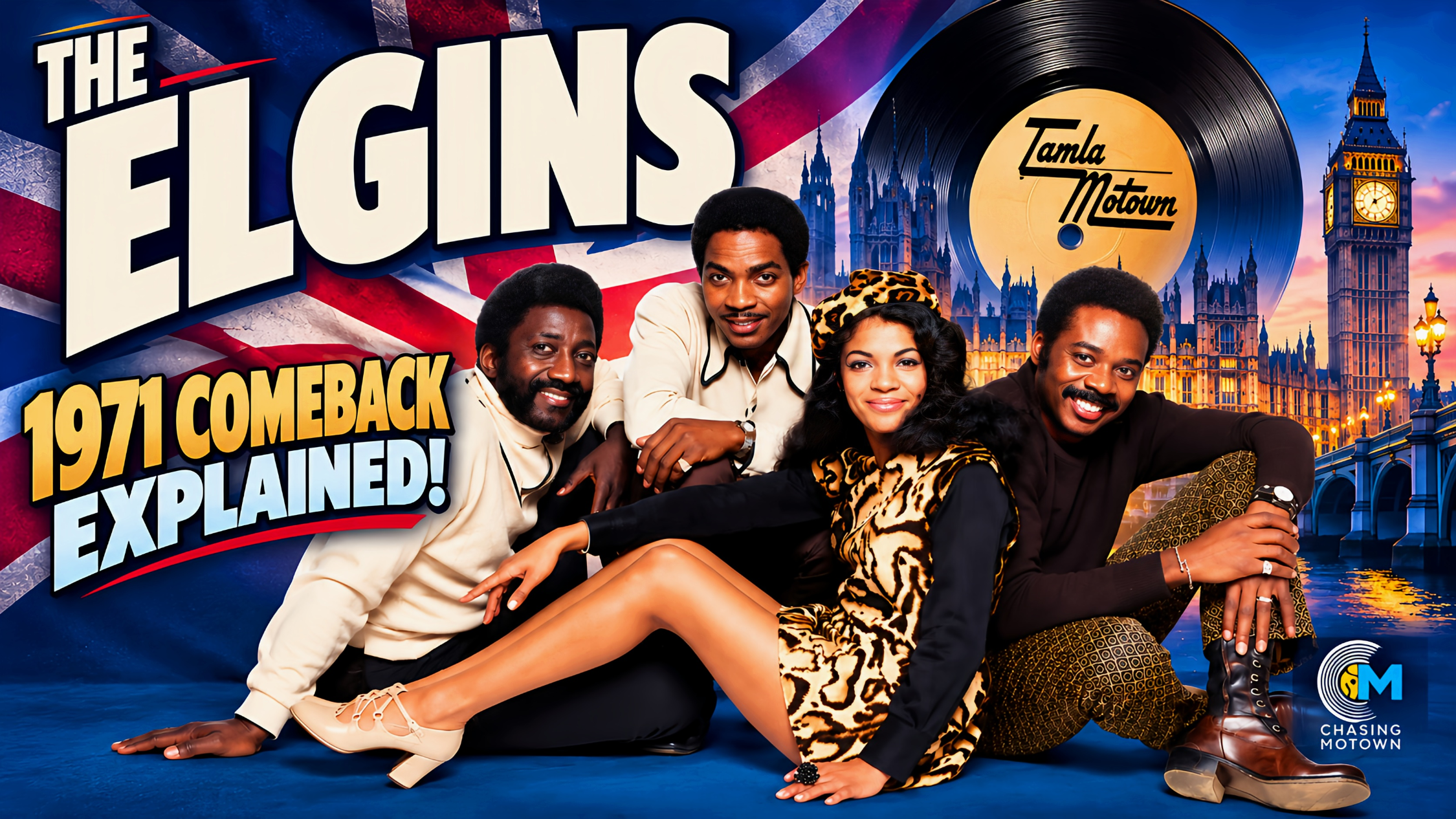
The Elgins (left to right): Johnny Dawson, Norman McLean, Yvonne Vernee and Duke Miller. Chasing Motown commemorative artwork celebrating the group's remarkable 1971 British comeback.
How does a Detroit vocal group that disbanded in 1967 suddenly find itself enjoying a major British chart hit in 1971, appearing on national television and performing for audiences thousands of miles from home?
And how does that happen with a different lead singer?
For years, the remarkable British comeback of The Elgins has been one of those fascinating little Motown curiosities that seemed to deserve a closer look.
Of course, many Motown enthusiasts are well acquainted with the group's wonderful Holland-Dozier-Holland recordings, particularly "Darling Baby" and "Heaven Must Have Sent You."
But the circumstances surrounding their unexpected return raise a much bigger question.
Why did Britain embrace recordings that had already been available for years, and why did some of those records become considerably more successful the second time around?
The answer takes us beyond The Elgins themselves, into Britain's devoted Motown community, the changing world of British radio, and a remarkable period when yesterday's Detroit recordings were becoming tomorrow's British pop hits.
The Elgins: Two Classics and an Unexpected Goodbye
The story begins in Detroit with a vocal group originally known as The Downbeats.
The male members had been associated with Motown during the label's early years before Saundra Mallett joined as lead vocalist. With their new configuration came a new name: The Elgins.
Under the direction of Motown's celebrated songwriting and production team Holland-Dozier-Holland, the group recorded two selections that would eventually become enduring favorites among soul enthusiasts.
"Darling Baby," released in 1965, introduced many listeners to the group's distinctive blend of male harmonies and Saundra's expressive lead vocals.
Then came "Heaven Must Have Sent You" in 1966.
With its irresistible rhythm, soaring melody and unmistakable Motown production, the recording possessed many of the qualities that had already made Holland-Dozier-Holland one of the most successful creative teams in popular music.
Yet commercial success in America was comparatively modest.
"Heaven Must Have Sent You" reached No. 50 on the Billboard Hot 100. It was hardly a failure, but it didn't establish The Elgins among Motown's major crossover attractions.
By 1967, the original lineup had disbanded.
And that remains one of the more intriguing aspects of their story.
Looking back, it seems surprisingly early for a group with two such wonderful recordings already to its credit to call it quits. One might imagine they could have continued performing for years on the strength of those songs alone.
But hindsight is a wonderful thing.
We weren't there, and the realities of the recording industry in 1967 were quite different from the way we appreciate those recordings today. A song's enduring reputation among collectors doesn't necessarily tell us what opportunities were available to its performers at the time.
Still, the group's original chapter had come to an end.
At least for the moment.
Britain Had Developed a Different Relationship with Motown
To understand what happened next, we need to consider something distinctive about Motown's reception in Britain.
In America, the label's commercial fortunes were closely associated with individual hitmakers: The Supremes, The Temptations, The Four Tops, Marvin Gaye, Martha and the Vandellas, and numerous others.
British listeners certainly embraced those stars, too.
But among dedicated British soul enthusiasts, something else was happening.
Motown itself was becoming an object of devotion.
For many collectors, the familiar Tamla Motown label represented a particular sound, a musical identity and an almost inexhaustible source of discoveries.
A new release didn't necessarily need to feature a superstar to attract attention. The fact that it came from Motown could be enough to make an enthusiast curious.
That distinction mattered enormously for artists whose American recordings hadn't achieved major crossover success.
The Elgins were precisely the kind of group whose records could find a second audience through that enthusiasm.
Dave Godin and the Early British Motown Enthusiasts
Among the influential figures in this developing culture was Dave Godin, whose enthusiasm for Motown helped establish a community of British listeners devoted to the Detroit label.
Godin was closely associated with the Tamla Motown Appreciation Society, which helped connect collectors, promote recordings and encourage interest in artists who might otherwise have remained unfamiliar to British audiences.
This wasn't simply a matter of following whichever Motown act happened to be enjoying a chart hit.
It was an appreciation of the label's broader musical output.
For American readers accustomed to thinking about Motown through its major chart successes, that distinction helps explain why Britain would later embrace so many recordings that had previously attracted relatively modest attention.
But devoted collectors and enthusiastic soul clubs were only part of the story.
There was another obstacle standing between those recordings and the wider British public.
Radio.
Before Radio 1: When Soul Music Had to Find Its Own Way
For much of the 1960s, British radio operated under a very different system from American broadcasting.
The United States had numerous commercial radio stations, including outlets serving Black audiences and stations specializing in rhythm and blues.
Britain, by contrast, was dominated by the BBC.
And although American popular music certainly received exposure, BBC radio programming was designed to accommodate an extraordinarily broad range of musical tastes.
Pop records shared airtime with traditional ballads, crooners, dance bands, novelty recordings and other forms of entertainment.
There was no equivalent nationwide BBC radio service devoted to the latest American soul and R&B releases.
That didn't mean Britain lacked an audience for the music.
Quite the opposite.
Throughout the mid-1960s, soul music was finding enthusiastic listeners in discotheques, dance clubs and among young record collectors.
Offshore pirate radio stations, along with Radio Luxembourg, offered alternatives to the BBC's more traditional programming.
They introduced listeners to records that might otherwise have struggled to receive widespread exposure.
Motown was an important part of that developing musical culture.
But there was a significant difference between a record becoming popular among dedicated soul enthusiasts and becoming a major national pop hit.
The audience existed.
What was still developing was the means to reach the wider record-buying public.
And in 1967, that situation began to change dramatically.
September 1967: The British Radio Revolution
The launch of BBC Radio 1 on September 30, 1967, represented an important turning point in British popular music broadcasting.
The British government's legislation targeting offshore pirate radio stations had forced major changes in the broadcasting landscape.
Meanwhile, the popularity of those stations had demonstrated that younger listeners wanted considerably more contemporary pop music than traditional BBC programming had offered.
Radio 1 was the BBC's response.
It introduced a dedicated popular music service and brought several personalities associated with the pirate radio era into mainstream broadcasting.
Among them was Tony Blackburn.
Tony Blackburn and Motown's Wider British Audience
Blackburn became the first voice heard on Radio 1 when the service launched, and his breakfast programme would become one of Britain's most influential popular music broadcasts.
His enthusiasm for Motown was particularly significant.
For dedicated collectors and soul club regulars, Motown recordings were already familiar territory.
But national radio could introduce those same recordings to an entirely different audience: casual listeners who weren't necessarily visiting specialist record shops or following the latest developments in American soul.
That broader exposure helped create opportunities for older Motown recordings to become successful pop singles.
It's important not to reduce the story to one DJ or one programme. British record buyers, specialist clubs, distributors, collectors and broadcasters all played roles in the growing popularity of the Detroit sound.
But the changing radio environment was a crucial part of the transformation.
And the evidence was beginning to appear on the charts.
When Yesterday's Motown Recordings Became Britain's New Hits
Consider The Isley Brothers' "This Old Heart of Mine (Is Weak for You)."
Originally released in 1966, the Holland-Dozier-Holland production became a major British hit in 1968, reaching No. 3.
Then there was The Temptations' "Get Ready."
Another recording dating from 1966, it returned to British attention and reached No. 10 in 1969.
These weren't newly recorded performances.
They were earlier Motown releases finding renewed commercial success in a changing British marketplace.
Of course, not every older Motown recording followed the same path, and the popularity of individual records reflected a combination of circumstances.
But a pattern was emerging.
Britain's devoted soul enthusiasts had helped establish an audience for Motown's catalogue, while changing radio programming and record-company reissues created opportunities for selected recordings to reach the mainstream.
A record that had arrived too early for one moment could become perfectly suited to another.
And by 1971, that remarkable phenomenon would give The Elgins an unexpected second career.
1971: "Heaven Must Have Sent You" Finds Its Moment
Nearly five years after its original American release, "Heaven Must Have Sent You" was back in circulation in Britain.
The recording had remained part of the music embraced by British soul enthusiasts, and EMI, which handled Tamla Motown releases in the United Kingdom, reissued the single.
This time, the response was extraordinary.
In 1971, "Heaven Must Have Sent You" climbed all the way to No. 3 on the UK Singles Chart.
The contrast was remarkable.
In America, the record had peaked at No. 50 on the Billboard Hot 100.
In Britain, nearly five years later, it became one of the country's biggest pop hits.
For The Elgins, it was the kind of success that had largely eluded them during their original recording career.
But there was another remarkable aspect to this unexpected success.
The group's original lineup had disbanded years earlier, and Saundra Mallett Edwards, whose unforgettable lead vocal was heard on the hit recording, was no longer a member.
Yvonne Vernee, formerly of The Donays, had joined The Elgins in 1968.
Now, the group's renewed British popularity was about to bring this later lineup into the national spotlight.
The Elgins Return to the Spotlight — With a Different Lead Singer
With "Heaven Must Have Sent You" enjoying major British success, The Elgins suddenly found themselves receiving attention that few could have anticipated during their original recording career.
But the group British audiences would see in 1971 was not quite the same lineup that had recorded the hit five years earlier.
Saundra Mallett Edwards, whose wonderful lead vocals had helped define the original recording, was no longer with the group.
Yvonne Vernee, formerly of The Donays, had joined The Elgins in 1968, several years before the unexpected British chart breakthrough.
Vernee was no stranger to Detroit's recording scene, and her musical background made her a natural fit for the group.
Now, the renewed popularity of "Heaven Must Have Sent You" was opening doors that had seemed closed years earlier.
Consider the unusual circumstances.
British audiences had fallen in love with a recording featuring a vocalist who was no longer performing with the group.
Yet those same audiences now had an opportunity to see The Elgins performing again, with Vernee handling the lead vocals.
For longtime admirers of Saundra's original performance, that was certainly a notable difference.
Nevertheless, The Elgins had been given a remarkable opportunity.
Their music had found a second life.
The group travelled to Britain, made television appearances, including Top of the Pops, and performed for audiences whose enthusiasm had helped bring their recordings back into the spotlight.
And the success of "Heaven Must Have Sent You" wasn't the end of the story.
Another earlier Elgins recording was about to make its mark on the British charts.
October 30, 1971: Britain Gives The Elgins Another Hit
Following the extraordinary success of "Heaven Must Have Sent You," EMI reissued another earlier Elgins recording, "Put Yourself in My Place."
The song, also dating from the group's original Motown years, became another British chart success.
On October 30, 1971, "Put Yourself in My Place" reached No. 28 on the UK Singles Chart.
And today, October 30, 2026, marks the 55th anniversary of that remarkable achievement.
The reunited Elgins also brought the recording to British television audiences through Top of the Pops.
What had begun with the rediscovery of a five-year-old recording had developed into something much more substantial.
A Detroit vocal group whose original lineup had disbanded years earlier was now enjoying renewed recognition, performing on British television and celebrating two British chart hits in the same year.
And the recordings responsible had been sitting in the Motown catalogue all along.
Was This Northern Soul? The Story Is Bigger Than One Scene
The Elgins' British revival is often associated with the enthusiasm of the Northern Soul movement, and understandably so.
Britain's soul clubs and dedicated collectors played an important role in preserving interest in American recordings that hadn't necessarily become major pop hits.
But the story also illustrates why we need to distinguish between the specialist soul scene and the broader British pop audience.
The roots of Northern Soul were developing during this period, building on an existing culture of clubs, collectors and American soul music appreciation.
Yet by the early 1970s, some specialist dance floors were increasingly pursuing harder-to-find recordings rather than simply following the Motown releases becoming familiar through mainstream radio.
In other words, the relationship between the underground soul scene and national chart success wasn't always straightforward.
An earlier Motown recording could be treasured by dedicated enthusiasts long before it became a familiar radio hit.
And once a record crossed into the mainstream, its audience could become much larger than the original community that had helped keep interest in it alive.
The Elgins' comeback sits at the intersection of those developments.
Their story isn't exclusively about Northern Soul, nor is it simply about Radio 1.
It's about the interaction of dedicated listeners, changing broadcasting opportunities, record-company decisions and a British public increasingly receptive to the Motown sound.
Together, those forces helped give a forgotten chapter of a Detroit group's career a remarkable new beginning.
Motown: The Gift That Keeps on Giving
Looking back, The Elgins' remarkable British comeback stands as one of the early examples of something we've come to appreciate about Motown over the decades.
The music has an extraordinary ability to find new audiences, sometimes years after the original recordings were released.
The Elgins didn't need to return to the studio and record an entirely new hit to enjoy their British comeback.
They already had the songs.
What changed was the audience, the opportunity and the musical landscape surrounding them.
And that's what makes their story so special.
A record that had enjoyed relatively modest American pop success in 1966 became a major British hit in 1971.
A group whose original lineup had disbanded was given another opportunity to perform.
And British listeners helped demonstrate that the commercial life of a Motown recording didn't necessarily end when it disappeared from the American charts.
More than half a century later, we're still discovering, rediscovering and celebrating recordings from that extraordinary catalogue.
Some were major hits from the beginning.
Others took years to find their moment.
And still others are waiting to be discovered by listeners who weren't even born when the music was recorded.
Motown really is the gift that keeps on giving.
To Our British Chasers: What Do You Remember?
For those who were following the British soul scene in 1971, we'd particularly love to hear your memories.
Was "Heaven Must Have Sent You" already familiar to you through the soul clubs and discotheques before it became a national hit?
Did you first discover The Elgins through Radio 1, buy the reissued single, or see the group on Top of the Pops?
And do you remember how British audiences responded to Yvonne Vernee taking over the lead vocalist position?
For our American Chasers, was The Elgins' extraordinary British second chapter something you knew about, or is this another fascinating discovery from Motown's international history?
These are the stories worth keeping alive, and sometimes the most revealing details come from the people who experienced the music firsthand.
Welcome to Chasing Motown.
— The Motown Specialist